National Pantheon
The dome of Santa Engrácia, a building that took three centuries to finish, and the place where Portugal honours Camões, Amália, Eusébio and Sophia de Mello Breyner.
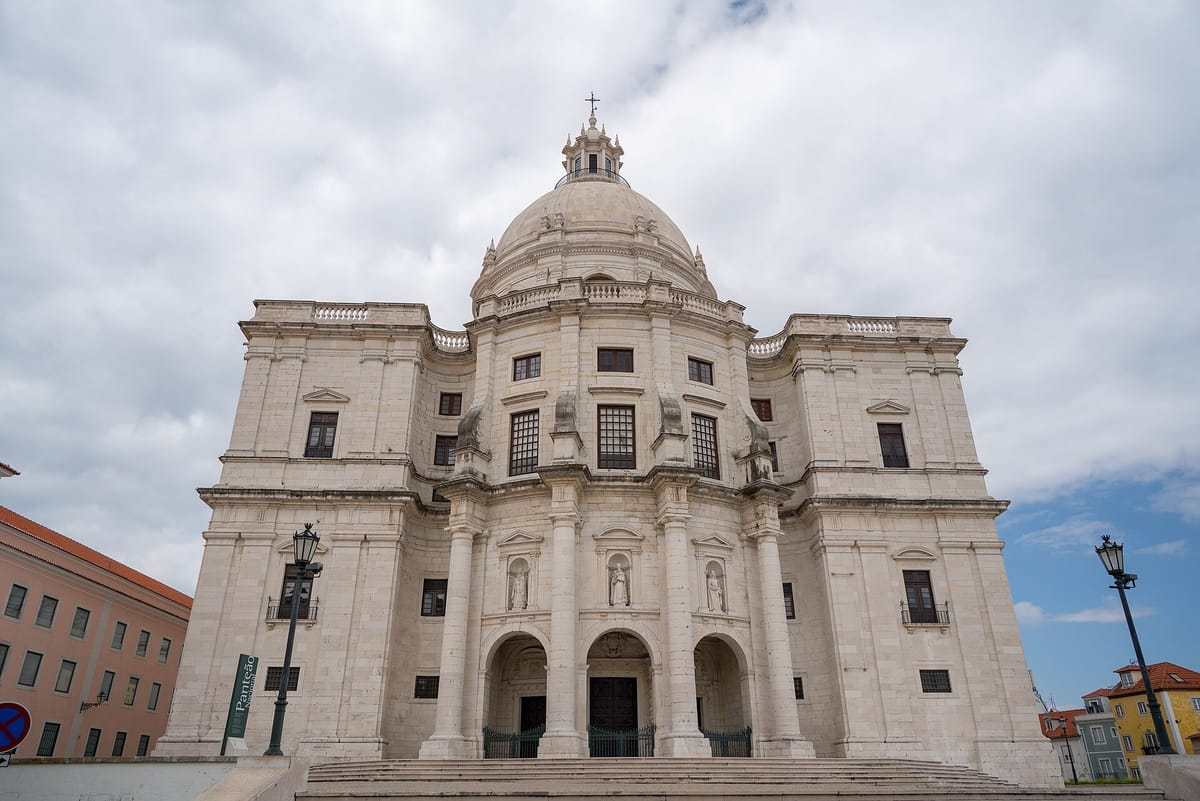
Church of Santa Engrácia
The National Pantheon occupies the former Church of Santa Engrácia, whose white dome rises above the rooftops of Alfama, next to Campo de Santa Clara. The story of the building explains a very Portuguese expression: the church was begun around 1570, its chancel collapsed in 1681 and, in 1682, the first stone was laid for a new design by master João Antunes – which would only be completed in 1966, almost three centuries later. Hence the "works of Santa Engrácia", said of something that never seems to end. Classified as a National Monument in 1910, it was designated the National Pantheon by a law of 1916. The interior, a Greek-cross plan with undulating walls, is a masterpiece of Portuguese Baroque clad in polychrome marble. It holds the cenotaphs of Luís de Camões, Vasco da Gama, Pedro Álvares Cabral, Afonso de Albuquerque, Nuno Álvares Pereira and Prince Henry the Navigator, and the tombs of presidents, writers such as Almeida Garrett, Sophia de Mello Breyner and Eça de Queiroz, Amália Rodrigues and Eusébio. From the terrace, 40 metres up, the view over the Tagus is unforgettable.
Located at: National Pantheon
Address: Campo de Santa Clara, 1100-471 Lisboa
Opening hours: 10:00-17:00 October to March, 10:00-18:00 April to September (closed on Mondays)
Phone: +351 218 854 820
Coordinates: 38.7149780, -9.1246825
Buses: 734, 712, 728, 735, 759, 781, 782
Tram: 28E
Metro: Santa Apolónia (Blue)
Train: Santa Apolónia station
Opened: 1682 (first stone laid, 344 years)