Gulbenkian Garden
On Avenida de Berna, the modernist garden by Ribeiro Telles and Viana Barreto, with ponds, lawns and Portuguese micro-landscapes.
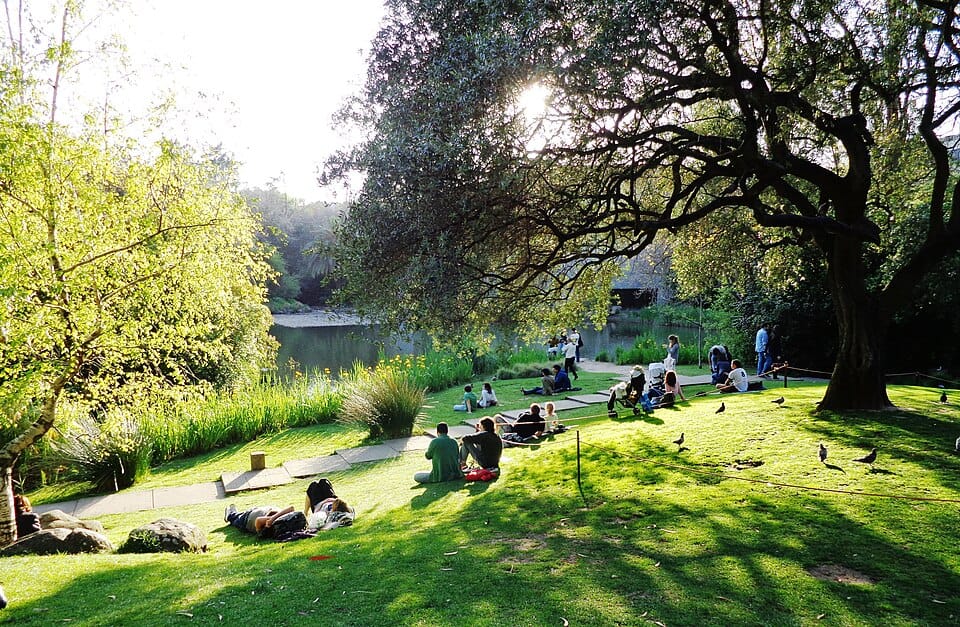
Gulbenkian Garden – Calouste Gulbenkian Foundation
The Gulbenkian Garden occupies part of the former Parque de Santa Gertrudes in Palhavã, laid out between 1866 and 1870 by the Swiss gardener Jacob Weiss for José Maria Eugénio de Almeida, who had bought the estate in 1861. The site later housed the Zoo, for ten years from 1883, and, from 1943, Lisbon's Feira Popular fairground. In 1957 the Calouste Gulbenkian Foundation bought the park, and the landscape architects António Viana Barreto and Gonçalo Ribeiro Telles designed the new garden, built throughout the 1960s in dialogue with the Headquarters and Museum buildings, inaugurated in 1969. It is one of the most emblematic gardens of the modern movement in Portugal: instead of axes, paths and flowerbeds it offers clearings and woodland edges, broad lawns, ponds and an open-air amphitheatre, creating 'micro-landscapes' inspired by the vernacular Portuguese landscape, with species chosen and combined according to the country's ecology. The vegetation attracts wildlife, especially birds and insects, which the Foundation introduces to the public through visits, workshops and courses throughout the year. The Foundation's building, which the garden surrounds, was classified as a national monument in 2010. Open every day from sunrise to sunset, the garden is free to enter.
Located at: Fundação Calouste Gulbenkian
Address: Av. de Berna, 45A, 1067-001 Lisboa
Opening hours: Daily, from sunrise to sunset (free admission)
Phone: +351 217 823 000
Coordinates: 38.7368881, -9.1541278
Buses: 716, 726, 756, 746, 52B, 713, 742
Metro: São Sebastião (Red, Blue), Praça de Espanha (Blue)
Train: Cintura Line, Entrecampos Station
Opened: 1969 (57 years)